
2026
Count on It: Numeracy, AI, and Social Mobility
Connect, PolicyWorking paper
2026.
@workingpaper{nokey,

title = {Count on It: Numeracy, AI, and Social Mobility},

author = {Policy Connect},

url = {https://policyconnect.org.uk/report/count-on-it-numeracy-ai-and-social-mobility/},

year  = {2026},

date = {2026-07-14},

keywords = {},

pubstate = {published},

tppubtype = {workingpaper}

}

Higher Education for Sustainable Transformation: Policy Messages from the HESI Community in 2026
Community, HESIWorking paper
2026.
@workingpaper{nokey,

title = {Higher Education for Sustainable Transformation: Policy Messages from the HESI Community in 2026},

author = {HESI Community },

url = {https://sdgs.un.org/sites/default/files/2026-07/HESI%202026%20Policy%20Messages.pdf},

year  = {2026},

date = {2026-07-01},

keywords = {},

pubstate = {published},

tppubtype = {workingpaper}

}

Written evidence: The use of Artificial Intelligence and EdTech in Education
Specht, Doug; Saunders, GunterWorking paper
2026.
@workingpaper{nokey,

title = {Written evidence: The use of Artificial Intelligence and EdTech in Education},

author = {Doug Specht and Gunter Saunders},

url = {https://committees.parliament.uk/writtenevidence/164835/html/

https://committees.parliament.uk/work/9642/the-use-of-artificial-intelligence-and-edtech-in-education/},

year  = {2026},

date = {2026-06-03},

publisher = {Education Committee},

institution = {UK Parliment},

keywords = {},

pubstate = {published},

tppubtype = {workingpaper}

}
Being indispensable: Capabilities for a human-AI world, the ‘FUTURES’ framework
Specht, Doug; Saunders, GunterWorking paperOpen Access
2026.
@workingpaper{nokey,

title = {Being indispensable: Capabilities for a human-AI world, the ‘FUTURES’ framework},

author = {Doug Specht and Gunter Saunders},

url = {https://www.hepi.ac.uk/reports/being-indispensable-capabilities-for-a-human-ai-world-the-futures-framework/},

year  = {2026},

date = {2026-03-05},

urldate = {2026-03-05},

publisher = {Higher Education Policy Institute},

abstract = {Artificial intelligence has inƮuenced higher education for many years, but the rapid growth of generative AI (GenAI) is accelerating change across teaching, learning and professional services. Early uses of AI focused on automation, such as intelligent tutoring systems or early warning analytics. GenAI, however, is now embedded directly in students’ and staƪ members’ everyday work.


Seventy-five per cent of young people aged 13-to-18 have already used GenAI, and similar patterns are emerging across universities. These tools can support idea generation, writing, feedback and administrative eƯciency, reshaping expectations of how learning happens and work gets done.


The opportunities are significant. GenAI can personalise learning, reduce staff workload and widen access to support. It can enable faster feedback, drive change in assessment approaches and provide greater Ʈexibility in how our students and staff complete tasks. At the same time, there are tangible, concerning risks. The Large Language Models (LLMs) that make tools like ChatGPT work can reƮect bias within their training data. Access to the most capable GenAI tools by students who can aƪord them may deepen inequalities, and the use of GenAI without due critical evaluation of any output can weaken independence, originality and authentic learning. Concerns around environmental impact add an additional layer of complexity.


This report argues that higher education requires a dual response: eƪective integration of GenAI, and systematic development of the human capabilities that remain essential in an AI-rich world. The FUTURES framework provides a practical model, oƪering seven domains – ranging from digital Ʈuency and ethical judgement to resilience, wellbeing and social intelligence – that can be embedded across curricula, assessment and institutional strategy.


The report focuses specifically on the role of GenAI in teaching and learning within higher education institutions. While GenAI clearly has significant implications for the research community, from literature synthesis and data analysis to hypothesis generation and collaborative knowledge production, the scope of this report is intentionally circumscribed to pedagogical practice and the wider student experience.


By maintaining this focus on teaching and learning, rather than on research excellence or institutional knowledge production, we are better able to examine in depth the challenges of higher education pedagogy and the student experience. Educational institutions have a responsibility to ensure that GenAI adoption aligns with the well-established principles of authentic learning, critical 4 Being indispensable: Capabilities for a human-AI world, the ‘FUTURES’ framework thinking development and equitable access. The risks and opportunities that emerge in the teaching and learning context diƪer in nature and severity from those facing the research community, and warrant dedicated, sustained attention.


Retaining our teaching and learning focus allows us to provide institutions with actionable guidance rooted in pedagogical values and student outcomes, rather than spreading analysis too thinly across the multiple and sometimes competing demands placed on universities.


For policymakers and university leaders, there are significant implications to consider. Institutions need clear approaches to GenAI-enabled learning, supported by practical governance, AI literacy training and equal access to GenAI tools. Curricula should purposefully integrate human-AI collaboration while ensuring ethical reasoning, critical thinking and wellbeing remain central to any overarching policy or strategy. Sector bodies have a role to provide guidance on assessment design in an AI-enabled environment, and government must invest in capability building to ensure students and staff can prosper in a world where GenAI is seen as a partner or co-worker / assistant. By adopting the FUTURES framework, we believe universities can find a ‘middle’ path with GenAI, enhancing human potential while navigating the opportunities and risks of AI more broadly.},

keywords = {},

pubstate = {published},

tppubtype = {workingpaper}

}
Seventy-five per cent of young people aged 13-to-18 have already used GenAI, and similar patterns are emerging across universities. These tools can support idea generation, writing, feedback and administrative eƯciency, reshaping expectations of how learning happens and work gets done.
The opportunities are significant. GenAI can personalise learning, reduce staff workload and widen access to support. It can enable faster feedback, drive change in assessment approaches and provide greater Ʈexibility in how our students and staff complete tasks. At the same time, there are tangible, concerning risks. The Large Language Models (LLMs) that make tools like ChatGPT work can reƮect bias within their training data. Access to the most capable GenAI tools by students who can aƪord them may deepen inequalities, and the use of GenAI without due critical evaluation of any output can weaken independence, originality and authentic learning. Concerns around environmental impact add an additional layer of complexity.
This report argues that higher education requires a dual response: eƪective integration of GenAI, and systematic development of the human capabilities that remain essential in an AI-rich world. The FUTURES framework provides a practical model, oƪering seven domains – ranging from digital Ʈuency and ethical judgement to resilience, wellbeing and social intelligence – that can be embedded across curricula, assessment and institutional strategy.
The report focuses specifically on the role of GenAI in teaching and learning within higher education institutions. While GenAI clearly has significant implications for the research community, from literature synthesis and data analysis to hypothesis generation and collaborative knowledge production, the scope of this report is intentionally circumscribed to pedagogical practice and the wider student experience.
By maintaining this focus on teaching and learning, rather than on research excellence or institutional knowledge production, we are better able to examine in depth the challenges of higher education pedagogy and the student experience. Educational institutions have a responsibility to ensure that GenAI adoption aligns with the well-established principles of authentic learning, critical 4 Being indispensable: Capabilities for a human-AI world, the ‘FUTURES’ framework thinking development and equitable access. The risks and opportunities that emerge in the teaching and learning context diƪer in nature and severity from those facing the research community, and warrant dedicated, sustained attention.
Retaining our teaching and learning focus allows us to provide institutions with actionable guidance rooted in pedagogical values and student outcomes, rather than spreading analysis too thinly across the multiple and sometimes competing demands placed on universities.
For policymakers and university leaders, there are significant implications to consider. Institutions need clear approaches to GenAI-enabled learning, supported by practical governance, AI literacy training and equal access to GenAI tools. Curricula should purposefully integrate human-AI collaboration while ensuring ethical reasoning, critical thinking and wellbeing remain central to any overarching policy or strategy. Sector bodies have a role to provide guidance on assessment design in an AI-enabled environment, and government must invest in capability building to ensure students and staff can prosper in a world where GenAI is seen as a partner or co-worker / assistant. By adopting the FUTURES framework, we believe universities can find a ‘middle’ path with GenAI, enhancing human potential while navigating the opportunities and risks of AI more broadly.
2025
Specht, DougTechnical Report
2025.
@techreport{nokey,

title = {The Environment in Focus},

author = {Doug Specht},

url = {https://committees.parliament.uk/work/9336/the-environment-in-focus/publications/written-evidence/?SearchTerm=specht&DateFrom=&DateTo=&SessionId=


https://committees.parliament.uk/writtenevidence/149652/html/},

year  = {2025},

date = {2025-12-01},

publisher = {Environmental Audit Committee},

keywords = {},

pubstate = {published},

tppubtype = {techreport}

}
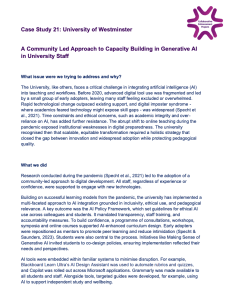
A Community Led Approach to Capacity Building in Generative AI in University Staff
Specht, Doug; Saunders, GunterTechnical Report
2025.
@techreport{nokey,

title = {A Community Led Approach to Capacity Building in Generative AI in University Staff},

author = {Doug Specht and Gunter Saunders},

url = {https://www.qaa.ac.uk/docs/qaa/members/case-study-21.pdf?sfvrsn=7a2da981_5


https://www.qaa.ac.uk/en/membership/benefits-of-qaa-membership/collaborative-enhancement-projects/generative-ai/exploring-the-opportunities-that-generative-artificial-intelligence-offers-for-higher-education/an-evidence-based-toolkit-on-leveraging-generative-ai-to-support-the-graduates-of-the-future},

year  = {2025},

date = {2025-11-20},

urldate = {2025-11-20},

publisher = {QAA},

series = {An evidence-based toolkit on leveraging Generative AI to support the graduates of the future},

keywords = {},

pubstate = {published},

tppubtype = {techreport}

}
House of Lords Communications and Digital Select Committee inquiry: Media literacy
Specht, Doug (Ed.)Technical Report
2025.
@techreport{nokey,

title = {House of Lords Communications and Digital Select Committee inquiry: Media literacy},

editor = {Doug Specht},

url = {https://committees.parliament.uk/committee/170/communications-and-digital-committee/news/208665


https://publications.parliament.uk/pa/ld5901/ldselect/ldcomm/163/163.pdf


https://committees.parliament.uk/work/9030/media-literacy/publications/},

year  = {2025},

date = {2025-05-02},

urldate = {2025-05-02},

publisher = {UK Parliment},

organization = {Communications and Digital Committee},

keywords = {},

pubstate = {published},

tppubtype = {techreport}

}

Specht, DougTechnical Report
Commons Select Committee 2025.
@techreport{nokey,

title = {Written evidence: Protection not permission: The UK’s role in upholding international humanitarian law and supporting the safe delivery of humanitarian aid},

author = {Doug Specht},

url = {https://publications.parliament.uk/pa/cm5901/cmselect/cmintdev/526/report.html


https://committees.parliament.uk/committee/98/international-development-committee/


https://committees.parliament.uk/work/8709/humanitarian-access-and-adherence-to-international-humanitarian-law/publications/ },

year  = {2025},

date = {2025-02-17},

urldate = {2025-02-17},

publisher = {International Development Committee},

institution = {Commons Select Committee},

keywords = {},

pubstate = {published},

tppubtype = {techreport}

}
Written evidence: Use of AI in Government
Specht, DougTechnical Report
Commons Select Committee 2025.
@techreport{nokey,

title = {Written evidence: Use of AI in Government},

author = {Doug Specht},

url = {https://committees.parliament.uk/work/8580/use-of-ai-in-government/publications/},

year  = {2025},

date = {2025-01-30},

urldate = {2025-01-30},

publisher = {Public Accounts Committee},

institution = {Commons Select Committee},

keywords = {},

pubstate = {published},

tppubtype = {techreport}

}
2024

Case Study: Blackboard Learn Ultra’s AI Design Assistant
Moule, TomTechnical Report
2024.
@techreport{nokey,

title = {Case Study: Blackboard Learn Ultra’s AI Design Assistant},

author = {Tom Moule},

url = {https://nationalcentreforai.jiscinvolve.org/wp/2024/04/24/case-study-blackboard-learn-ultras-ai-design-assistant/},

year  = {2024},

date = {2024-04-24},

urldate = {2024-04-24},

publisher = {JISC},

abstract = {Virtual Learning Environments (VLEs) – a ubiquitous tool in tertiary education – have begun to harness generative AI, leading to exciting new features and functionality. In this case study, we explore how University of Westminster and Northumbria University have been utilising Blackboard® Learn Ultra’s AI Design Assistant, which includes features that generate assessment rubrics, course structures, activity ideas, images, and quizzes and knowledge checks. },

keywords = {},

pubstate = {published},

tppubtype = {techreport}

}
AI Garage – snapshots of practice
Knight, CharlesWorking paper
2024.
@workingpaper{nokey,

title = {AI Garage – snapshots of practice},

author = {Charles Knight

},

url = {https://www.advance-he.ac.uk/news-and-views/ai-garage-snapshots-practice?utm_campaign=Comms+2024&utm_medium=social&utm_source=LinkedIn},

year  = {2024},

date = {2024-04-23},

urldate = {2024-04-23},

publisher = {AdvanceHE},

abstract = {This newly released 'AI Garage' Overview report offers an insight into the increasing influence of generative artificial intelligence (GAI) across higher education institutions (HEIs). As the technology evolves, so does GAI’s role in existing processes, systems and cultures.


The report highlights the innovations and challenges of integrating GAI into existing practices, from enhancing student learning experiences through personalized learning paths to augmenting faculty capabilities in handling academic pressures.


The case studies, derived from various submissions, reflect a ‘garage band’ spirit of creativity and collaborative experimentation within the academic community.


We know this is a highly contested area (as noted in the report) — viewed by some as a ground-breaking tool poised to redefine pedagogical and research approaches. In contrast, others remain cautious, citing potential risks and the hype that often surrounds emerging technologies. Regardless of these differing viewpoints, the current wave of experimentation across HEIs underscores a significant digital exploration and adaptation period.


For those interested in a deeper exploration of the themes and case studies presented in the AI Garage Report, further details can be accessed through the dedicated project URLs provided in the report appendix.  },

keywords = {},

pubstate = {published},

tppubtype = {workingpaper}

}
The report highlights the innovations and challenges of integrating GAI into existing practices, from enhancing student learning experiences through personalized learning paths to augmenting faculty capabilities in handling academic pressures.
The case studies, derived from various submissions, reflect a ‘garage band’ spirit of creativity and collaborative experimentation within the academic community.
We know this is a highly contested area (as noted in the report) — viewed by some as a ground-breaking tool poised to redefine pedagogical and research approaches. In contrast, others remain cautious, citing potential risks and the hype that often surrounds emerging technologies. Regardless of these differing viewpoints, the current wave of experimentation across HEIs underscores a significant digital exploration and adaptation period.
For those interested in a deeper exploration of the themes and case studies presented in the AI Garage Report, further details can be accessed through the dedicated project URLs provided in the report appendix.
2023
MODEL REPORT: INFORM Risk Index
OCHA, UN (Ed.)Technical Report
2023.
@techreport{nokey,

title = {MODEL REPORT: INFORM Risk Index},

editor = {UN OCHA},

url = {https://camri.ac.uk/blog/2023/07/23/doug-specht-undertakes-ethical-review-for-un-report-on-inform-risk-index/},

year  = {2023},

date = {2023-07-01},

abstract = {This document summarizes the documentation and findings of the peer review of the INFORM Risk Index. The INFORM Risk Index is a global, open-source risk assessment for humanitarian crises and disasters. It can support decisions about prevention, preparedness and response. The objective of the INFORM Risk Index is to identify countries at risk of humanitarian crises that could overwhelm national capacity to respond. The model combines indicators of hazard and exposure, vulnerability and coping capacity into a composite indicator.

},

keywords = {},

pubstate = {published},

tppubtype = {techreport}

}
2020

Future Trends in Geospatial Information Management (3rd Edition
UN-GGIM, (Ed.)Working paperForthcomingOpen Access
Forthcoming.
@workingpaper{nokey,

title = {Future Trends in Geospatial Information Management (3rd Edition},

editor = {UN-GGIM},

url = {https://ggim.un.org/documents/DRAFT_Future_Trends_report_3rd_edition.pdf},

year  = {2020},

date = {2020-06-02},

keywords = {},

pubstate = {forthcoming},

tppubtype = {workingpaper}

}
2016
Future trends in geospatial information management: the five to ten year vision (2nd Edition)
UN-GGIM,Working paperOpen Access
2016.
@workingpaper{nokey,

title = {Future trends in geospatial information management: the five to ten year vision (2nd Edition)},

author = {UN-GGIM},

url = {http://ggim.un.org/documents/UN-GGIM-Future-trends_Second%20edition.pdf},

year  = {2016},

date = {2016-12-01},

urldate = {2016-12-01},

edition = {Future trends in geospatial information management: the five to ten year vision},

keywords = {},

pubstate = {published},

tppubtype = {workingpaper}

}
2015
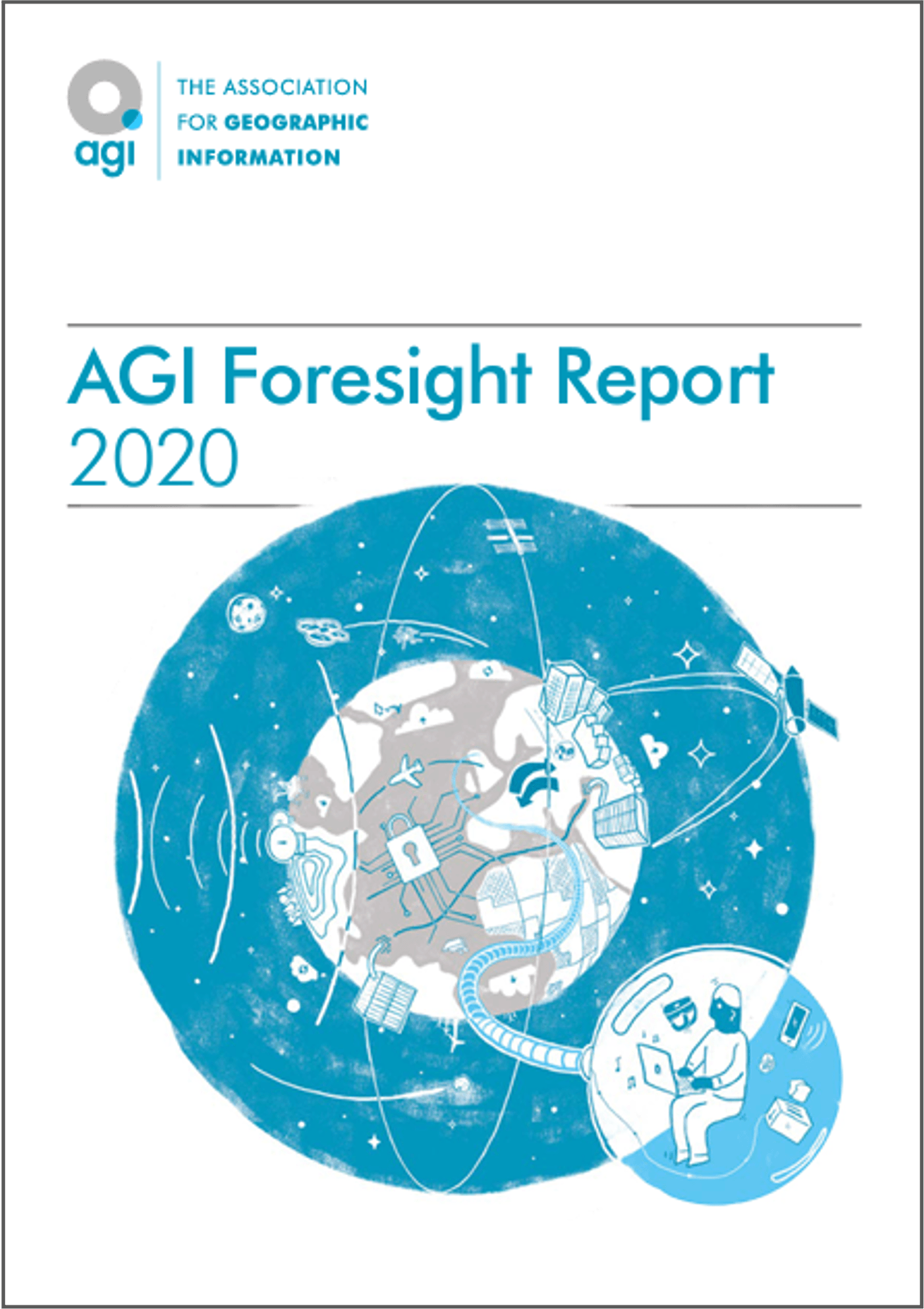
The Future of GI in the 3rd Sector
Specht, DougWorking paperOpen Access
2015.
@workingpaper{Specht2015,

title = {The Future of GI in the 3rd Sector},

author = {Doug Specht},

editor = {Association for Geographic Information},

url = {https://www.agi.org.uk/news/foresight-report},

year  = {2015},

date = {2015-11-30},

urldate = {2015-11-30},

pages = {235-239},

institution = {Association for Geographic Information},

organization = {Association for Geographic Information},

abstract = {The AGI Foresight Report 2020 gives insight into the issues we believe will have a significant impact on our economy, environment and society over the next five years. The purpose of the Report is to both observe and challenge the current role of Geographic Information (GI) in relation to these issues. The Report highlights five key themes that are of relevance not only to the GI industry, but to anyone with a vested interest in how technology and information will change our world and businesses in the next five years. These five themes – Open, Big Data, BIM and Future Cities, innovative technologies and policy – form the backbone of our Report, bringing together papers from experts across industries and disciplines. They show that the GI community can, and must, play a big part in helping us to understand and maximise benefits from these areas, and meet head on the challenges and opportunities the next five years will bring.},

keywords = {},

pubstate = {published},

tppubtype = {workingpaper}

}